

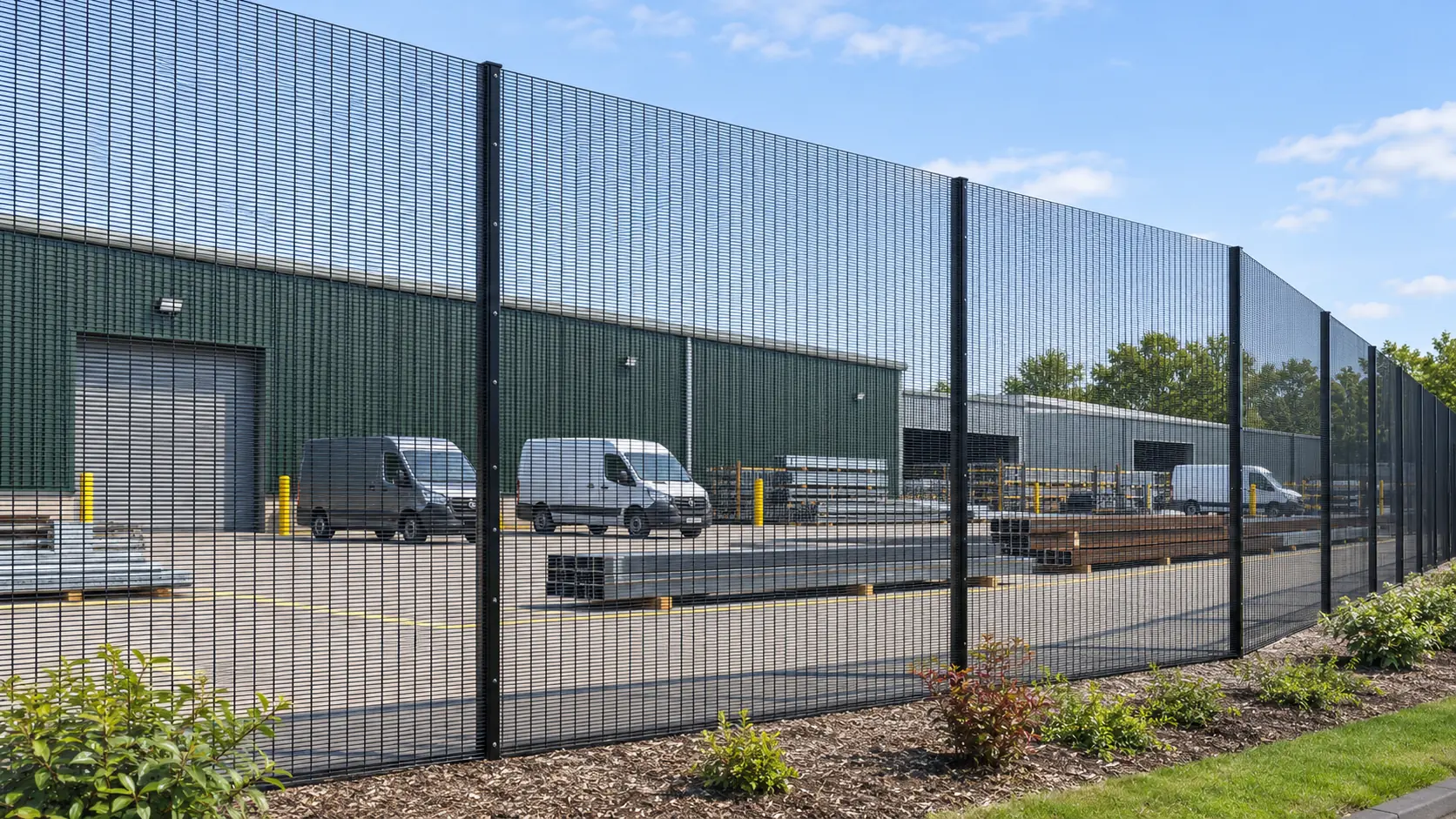
What Is 358 Mesh Fencing? A Buyer’s Guide to Security Mesh
Choosing fencing for a commercial site means considering more than the boundary’s appearance. You also need to think about access, visibility and how the fence will help protect your premises.
358 mesh fencing is a welded steel mesh system with closely spaced wires designed to make climbing difficult while allowing visibility through the boundary. It is often called anti-climb mesh or prison mesh fencing.
If you are considering a 358 mesh fencing kit, this guide explains the name, the benefits and the questions to ask before ordering.
What does “358” mean?
The name “358” describes the traditional mesh specification: the 3 refers to mesh spacing of 3 inches, the 5 represents 0.5 inches, and the 8 indicates 8-gauge wire, approximately 4mm thick. In metric terms, this is commonly described as 76.2mm × 12.7mm mesh spacing with approximately 4mm wire. This narrow rectangular pattern distinguishes 358 mesh from more open mesh designs. Always check the technical data for the particular system you are buying.
Why is 358 mesh called anti-climb fencing?
The closely spaced wires restrict opportunities to gain finger and footholds. This makes the mesh more difficult to climb than fencing with larger, accessible openings. Its tight configuration also makes access with conventional hand-cutting tools more difficult.
“Anti-climb” describes a design characteristic; it does not mean a fence is impossible to cross. When choosing a system, assess the complete boundary, including gates, fixing arrangements and nearby objects that could provide access over it.
For example, placing storage containers immediately beside a fence could undermine the purpose of choosing a climb-resistant mesh.
Can you see through 358 mesh fencing?
Yes. Despite its dense pattern, 358 mesh allows views through the fence and can support perimeter observation and CCTV use.
For a site with cameras, include the fence line in your camera-layout review. Check viewing angles and lighting rather than assuming every camera will have an unobstructed view through every section.
This also makes 358 mesh worth considering when you want a visible boundary without the enclosed appearance of a solid barrier.
Where is 358 mesh fencing used?
CLA identifies applications including warehouses, utility sites, data centres, transport infrastructure and secure compounds.
The right choice depends on the individual site. Start by asking what you need the boundary to achieve:
- Discourage unauthorised access.
- Define restricted areas.
- Allow staff to observe activity outside the perimeter.
- Integrate with controlled pedestrian and vehicle entrances.
- Meet a project’s specified security requirements.
For a project requiring independently tested security performance, request evidence for the exact system being proposed. The term “358 mesh” alone should not be treated as proof of a particular security rating.
What comes in CLA’s 358 Mesh Fencing Kit?
Our 358 Mesh Fencing Kit lists a mesh panel, a 60 × 60 SHS post, a post cap, mesh security bolts and mesh clips. The published specification gives post centres of 2,530mm. Confirm component quantities and suitability for your selected configuration when ordering.
Your overall layout may also require additional end posts, corner arrangements, gates and ground-fixing materials. A useful starting point is a simple sketch showing each fence run, entrance and change of direction.
What should you check before buying?
1. Fence height
Choose the height around your site requirements and project specification.
The CLA product page currently offers selectable heights of 1.8m, 2.0m and 2.4m. Confirm the exact panel dimensions and finished fence height for your chosen option before ordering.
2. Post type and ground conditions
CLA offers dig-in and bolt-down options.
Ask your installer to confirm the suitable arrangement, including foundation or anchor requirements. Describe the existing surface and any changes in level when requesting a quotation.
3. Gates and access
Plan entrances alongside the fencing. Record the clear opening needed for pedestrians, delivery vehicles and maintenance access.
Ask your supplier to confirm that the proposed gates, posts and locking arrangements suit the intended perimeter specification.
4. Finish and appearance
The kit’s listed colour choices include green, black, blue and red.
Consider how the fence will look beside existing buildings and boundaries. If you are extending an existing installation, confirm the colour reference and component compatibility.
5. Total project cost
Request a quotation that clearly separates materials, delivery, installation and groundworks. Include gates and additional posts so you can compare complete project costs.
For a more useful quote, provide measurements for each run rather than only the total perimeter length.
Is 358 mesh fencing right for your site?
358 mesh is worth considering when climb resistance and visibility are priorities. Your final choice should also account for the site layout, access requirements, installation conditions and any specified security performance.
If you are still comparing systems, read our guide to V mesh, 656, 868 and 358 fencing.
Plan your project with CLA Security Fencing Systems
Ready to choose your fencing? Send us your fence-run measurements, preferred height, gate requirements and delivery postcode. Include a layout sketch if you have one, and ask us to confirm the components required.