

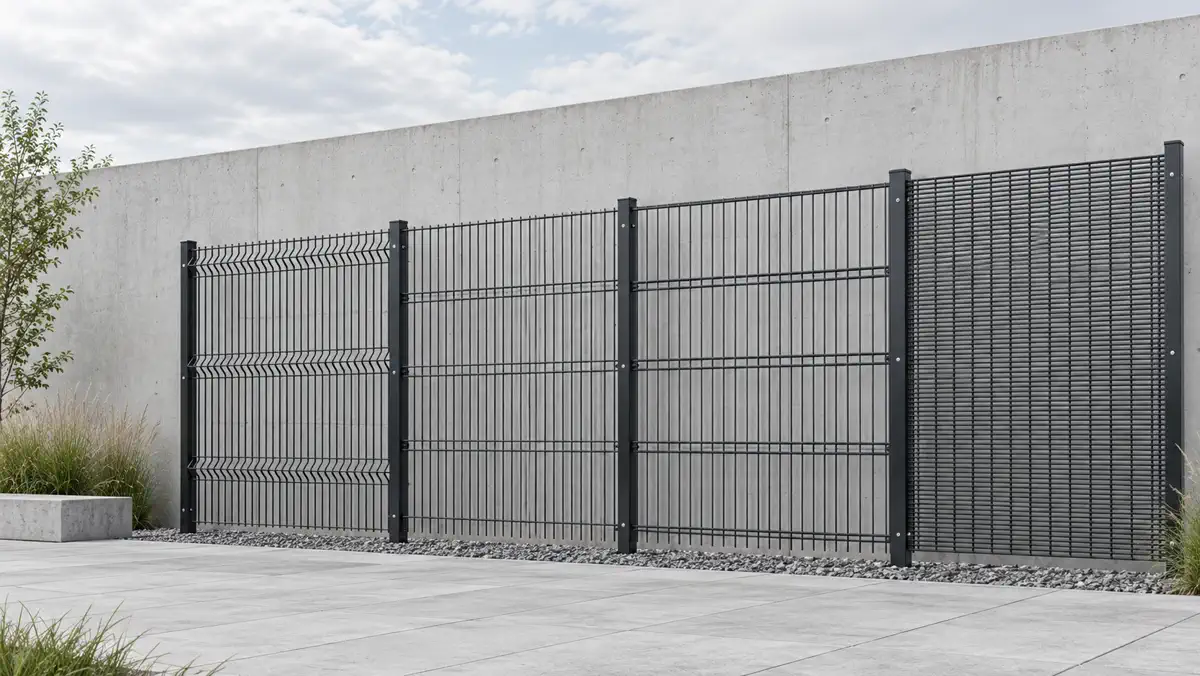
Types of Mesh Fencing Explained: V Mesh vs 656, 868 and 358
Mesh fencing is used around schools, warehouses, industrial premises, sports facilities and other commercial sites. It provides a durable physical boundary while maintaining visibility through the perimeter.
However, not all mesh fencing is the same. V mesh, 656 twin wire, 868 twin wire and 358 security mesh each offer a different combination of strength, security, appearance and cost.
This guide explains the main types of mesh fencing and helps you identify the right system for your site.
What is mesh fencing?
Mesh fencing consists of steel wires welded together to form rigid panels. The panels are fixed to steel posts using clips, brackets or clamp bars.
A typical mesh fencing system includes:
- Welded mesh panels
- Steel posts
- Clips or clamp bars
- Security fixings
- Pedestrian or vehicle gates
- A galvanised or powder-coated finish
Because mesh fencing is not solid, staff and security cameras can retain a clear view across the boundary. The panel’s wire thickness, aperture size and profile determine much of its strength and resistance to climbing.
Security does not depend on the panel alone. Fence height, posts, fixings, gates and installation quality all affect the performance of the complete system.
What is V mesh fencing?
V mesh fencing has horizontal folds pressed into each welded wire panel. These V-shaped profiles increase rigidity without requiring the heavier wires found in twin-wire systems.
It provides an effective balance between appearance, strength and cost, making it one of the most popular choices for general commercial boundaries.
Benefits of V mesh fencing
- Good visibility
- Attractive, unobtrusive appearance
- Reinforced panel design
- Cost-effective construction
- Choice of heights and colours
- Compatible pedestrian and vehicle gates
V mesh fencing is commonly used around schools, parks, housing developments, offices, retail premises, car parks and light-industrial sites.
It is a practical general-purpose system, although locations facing a substantial climbing or intrusion risk may require a more specialised option.
What is 656 twin-wire fencing?
A 656 panel generally uses two 6mm horizontal wires positioned around a 5mm vertical wire. This twin-wire construction produces a flat and rigid panel.
The numbers describe the wire configuration:
- First 6: front horizontal wire
- 5: vertical wire
- Second 6: rear horizontal wire
Specifications may vary between products, so always check the supplier’s current technical information.
Benefits of 656 mesh fencing
- Strong twin-wire design
- Good resistance to bending
- Clear visibility through the perimeter
- Clean, professional appearance
- Suitable for long fence runs
- Balance between strength and cost
656 mesh fencing is regularly considered for schools, offices, warehouses, parks, public spaces and moderate-risk industrial boundaries.
Compared with V mesh, it offers a flatter and more rigid panel. It can be a suitable step up when a site requires additional strength but does not need the heavier construction of 868 mesh.
What is 868 twin-wire fencing?
An 868 panel generally uses two 8mm horizontal wires surrounding a 6mm vertical wire. Its heavier wire configuration provides greater rigidity than 656 fencing.
This makes it suitable for demanding environments where the boundary may experience greater pressure, impact or attempted damage.
Benefits of 868 mesh fencing
- Heavy-duty panel construction
- High resistance to bending
- Strong long-term rigidity
- Good visibility for CCTV
- Substantial appearance
- Suitable for higher-risk sites
868 fencing is often specified for warehouses, industrial premises, utility compounds, commercial yards and transport-related locations.
Its heavier construction usually makes it more expensive than V mesh or 656 fencing. The additional cost should therefore be considered against the site’s actual risks.
What is 358 security mesh fencing?
358 security mesh is recognised by its narrow rectangular apertures. The name traditionally refers to an aperture approximately 3 inches by 0.5 inches with 8-gauge wire, although the exact metric specification should be confirmed for each product.
The closely spaced openings provide little room for hands or feet, making the fence difficult to climb. They may also restrict access for common cutting tools.
For these reasons, 358 fencing is frequently described as anti-climb or prison mesh.
Benefits of 358 mesh fencing
- Strong climbing deterrent
- Narrow apertures
- Good visibility for guards and CCTV
- Suitable for tall perimeter systems
- Security-focused appearance
- Compatible with high-security posts and fixings
Typical applications include secure commercial compounds, utility sites, transport facilities, data centres, high-value storage areas and critical infrastructure.
The phrase “anti-climb” does not mean that a fence is impossible to climb. It describes features intended to make climbing much more difficult.
It is also important to distinguish a 358 panel from a certified security system. If a project requires an LPS 1175 or other recognised rating, the complete fencing system must hold the relevant certification.
What is sports mesh fencing?
Sports mesh fencing is designed for courts, pitches and multi-use games areas. It balances visibility, durability and ball containment while helping to create a safe playing environment.
Common applications include:
- Football pitches
- Tennis courts
- Basketball courts
- Multi-use games areas
- School sports facilities
Sports enclosures may require different fence heights in different locations. For example, taller fencing might be needed behind a goal than along the sides of a pitch.
V mesh vs 656 fencing
V mesh uses pressed folds to make the panel more rigid. It is a cost-effective and attractive choice for general commercial, educational and public boundaries.
656 fencing uses a twin-wire arrangement to provide additional rigidity. It may be preferable where panels could experience greater pressure or where a substantial flat-panel appearance is required.
The choice should reflect the site’s risk level, required height, preferred appearance and budget.
656 vs 868 fencing
Both systems use twin horizontal wires, but 868 fencing uses thicker wires and provides a heavier panel.
656 mesh is normally suitable for moderate-security commercial and public environments. It offers good strength without the weight and expense of 868 mesh.
868 may be more appropriate when:
- The site has a higher security risk
- Panels may face repeated pressure or impact
- Greater rigidity is required
- A heavier physical boundary is preferred
Choosing the heaviest panel is not always necessary. A properly specified 656 system may provide sufficient protection at a lower overall cost.
868 vs 358 fencing
868 and 358 fencing address different security priorities.
868 mesh provides strength through its heavy twin-wire construction. It is highly rigid and difficult to deform.
358 mesh uses narrow apertures to restrict grip and help deter climbing. It may therefore be more appropriate where anti-climb performance is the main concern.
For high-risk projects, compare complete fencing systems rather than choosing a panel based only on wire thickness.