

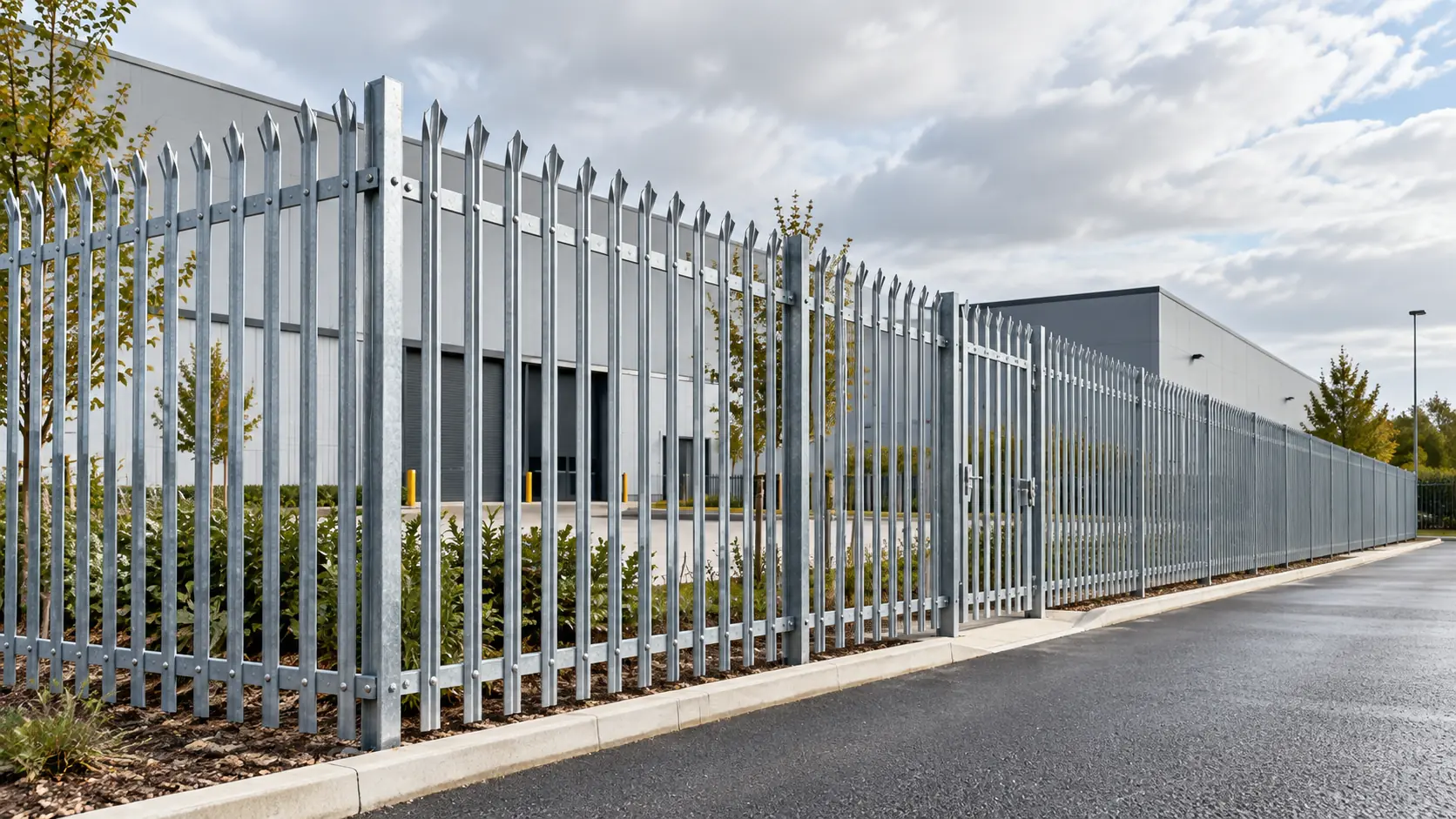
Palisade Fencing Cost in the UK: What Affects Your Project Price?
If you are budgeting for a warehouse, industrial estate, utility site or other commercial perimeter, it is natural to ask: how much does palisade fencing cost in the UK?
The honest answer is that there is no reliable single price per metre. The final cost depends on the length and height of the fence, the pale profile and finish, the post and foundation method, gates, delivery, installation and the complexity of the site.
Quick answer: For a meaningful palisade fencing cost, compare like-for-like specifications rather than a headline rate. A useful quote should state the materials supplied, fence height, pale style, post type, finish, gate requirements, delivery, VAT and any installation or groundwork costs separately.
At CLA Security Fencing Systems, we supply complete palisade fencing kits, matching palisade gates, replacement pales and accessories for commercial, industrial, infrastructure and public-sector projects across the UK. That makes it possible to build a price around the security and access requirements of your actual site, not an oversimplified average.
Current material price starting points
As reviewed on 2 October 2026, CLA’s live palisade kit category lists triple point, single point and rounded and notched kits from £147.15, and Network Rail palisade kits from £122.63. These are starting product prices, not an installed price per metre or a full project quotation.
The exact cost changes with the chosen height, finish, post type and quantity. Check the live product page before ordering, and confirm whether VAT, delivery, gates, installation and groundworks are included in the figure you are comparing.
Why one palisade fencing cost per metre can be misleading
Price per metre can be useful for an early budget, but only when every part of the specification is the same. Two quotes can look similar while covering very different scopes.
Before comparing figures, check:
- Is the price for materials only, or supply and installation?
- Is it quoted per bay, per linear metre or for the entire project?
- Are both quotes for the same finished height, pale profile and coating?
- Do they include end posts, corner posts, changes of level and fixing packs?
- Are gates, locks, delivery, offloading, VAT and groundworks included or separate?
A lower materials figure is not necessarily the lower project cost if essential components or site work have been left out.
1. Total fence length, bays and site layout
The first cost driver is the amount of perimeter to protect. However, a fencing plan is more than a measurement around the edge of a site.
For early planning, measure every straight run, then mark the locations of corners, ends, gates, returns and changes in direction. CLA’s triple point and single point kit specifications use 2,750 mm post centres, so a rough planning calculation is:
Approximate number of bays = total straight fence run in metres ÷ 2.75
Use that only as an initial guide. A detailed quote needs to allow for the layout of your particular site, including terminal and corner arrangements, gate openings and any changes of level.
2. Fence height
Palisade fencing is available in a range of heights. On CLA’s standard kit pages, options include 1.2 m, 1.5 m, 1.8 m, 2.0 m, 2.4 m and 3.0 m, depending on the chosen system.
As height increases, the material specification changes too. Decide the height from your security risk, perimeter visibility, neighbouring environment and site access requirements, not simply the lowest initial price.
3. Pale profile and security specification
The pale top profile has a direct effect on the appearance and security intent of the fence:
- Triple point palisade fencing provides a prominent visual deterrent for higher-security perimeters, such as depots, warehouses, utility sites and restricted-access areas.
- Single point palisade fencing is a robust, cost-effective choice for commercial and industrial boundaries.
- Rounded and notched palisade fencing uses a less aggressive pale profile where a safer appearance is required.
- Network Rail palisade fencing is available for rail and infrastructure projects.
Do not compare one pale profile with another unless the rest of the specification is also equivalent. The right choice is the one that suits your site’s required level of deterrence, safety and access control.
4. Posts, foundations and installation method
The fence needs to suit the surface and ground conditions at the installation location. A dig in system and a bolt down system are not interchangeable, and the correct approach will depend on the existing base, foundation design and site conditions.
When you request a price, state whether you need dig-in or bolt-down posts. If you are unsure, share photographs, drawings and details of the existing ground with your fencing supplier before comparing costs.
5. Galvanised and powder-coated finishes
Finish affects both appearance and long term maintenance planning. CLA’s palisade fencing kits are available in galvanised, green and black options, with other colours available on request. Its standard triple-point and single-point product specifications also list galvanising to BS EN ISO 1461.
For an accurate comparison, make sure each quote identifies:
- the finish required;
- the colour, where relevant;
- whether the price covers a standard or non-standard option; and
- any touch-up materials needed after installation or later repairs.
6. Gates, locks and access requirements
Gates are often one of the largest variables in a palisade fencing project. A matching single gate may be appropriate for pedestrian access, while a double gate or trackless cantilever gate may be needed for vehicles, deliveries or service access.
To price gates accurately, provide:
- the clear opening width;
- required height and finish;
- pedestrian, vehicle or sliding access use;
- opening direction or operating method;
- locking, keypad, intercom or access-control requirements; and
- any restrictions on space around the entrance.
Specifying the gate at the same time as the fence helps avoid an access solution that does not match the perimeter system.
7. Site complexity, delivery and installation
Materials are only one part of a project cost. A quotation for a level, accessible site with a straightforward fence line will differ from one for a sloping or constrained site.
Ask your supplier to make clear whether the price includes:
- delivery to your postcode;
- unloading or offloading requirements;
- removal of existing fencing;
- excavation, concrete or groundwork;
- installation labour;
- adjustments for slopes, level changes or obstacles; and
- site-specific access or working restrictions.
This clarity is particularly important when you are comparing a supply-only quote with a supply-and-install quotation.
8. Complete kit versus individual components
A complete kit can simplify ordering because its core parts are designed to work together. For example, CLA’s triple-point kit specification lists a palisade post, two horizontal angle rails, 17 pales, two fishplates and a fixing pack for the selected configuration.
Individual palisade pales and accessories are useful for repairs, extensions and upgrades, but a project price should account for every required component. Confirm whether the quote covers all posts, rails, pales, fishplates, fixings and any special parts needed for corners, ends or gates.
9. Quantity and project scale
Larger orders can change the unit price and delivery plan. CLA’s product pages show quantity-break pricing on qualifying palisade kit orders, but the available price and threshold depend on the live product configuration and order quantity.
If you are ordering for a long boundary, phased project or multiple sites, ask for a project quote. It is the most dependable way to compare a complete materials schedule, current quantity pricing and delivery requirements.