

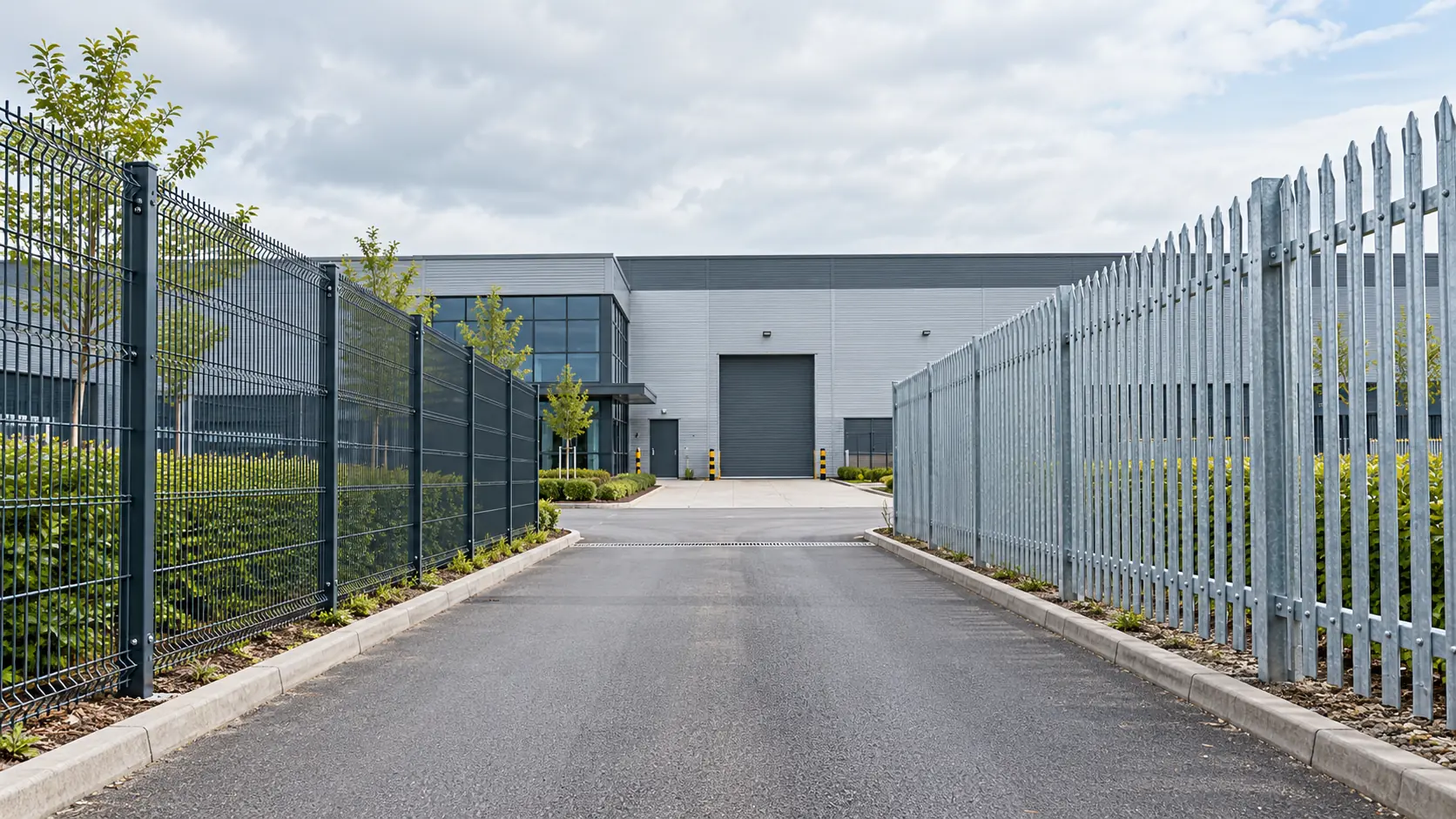
Mesh Fencing vs Palisade Fencing: Which Is Right for Your Site?
Choosing perimeter fencing means balancing security, appearance, budget and everyday access. Two options you’re likely to consider are mesh fencing and steel palisade fencing.
Mesh fencing is worth considering where visibility and a neat appearance matter, with systems available for general boundaries and more demanding security applications. Palisade fencing is an option for industrial premises where a prominent physical boundary and visual deterrent are priorities. CLA Security Fencing Systems supplies both ranges for commercial and industrial projects.
The right choice depends on the specific system and your site’s requirements. This guide explains what to compare before requesting a quotation.
What Is Mesh Fencing?
Mesh fencing uses wire panels supported by posts. Different panel designs serve different purposes, so it is important to understand which system you are comparing.
V mesh panels have pressed V-shaped profiles that add stiffness. They are a practical starting point for general commercial boundaries. Twin wire systems, including 656 and 868 mesh, use double horizontal wires for increased rigidity. CLA Security Fencing Systems also supplies 358 mesh for applications where resistance to climbing is a priority.
A general boundary panel and a security-focused mesh system should not be treated as interchangeable. Start with your site’s requirements, then select a suitable specification.
Explore mesh fencing from CLA Security Fencing Systems.
What Is Palisade Fencing?
Palisade fencing consists of individual vertical steel pales attached to horizontal rails and supported by posts.
The range from CLA Security Fencing Systems includes triple point, single point, and rounded and notched pale profiles. Triple point palisade provides a conspicuous deterrent, while rounded and notched options have a less aggressive appearance. Typical applications include depots, warehouses, storage yards and restricted-access areas.
The pale profile is one part of the specification. Fence height, posts, rails, fixings and installation arrangements should also form part of your comparison.
Explore palisade fencing from CLA Security Fencing Systems.
Mesh Fencing vs Palisade Fencing: Which Offers Better Security?
Neither fencing category is automatically more secure in every situation. Compare the complete systems against the risks your site faces.
Begin by identifying the purpose of the boundary. Do you need to discourage casual access, protect outdoor equipment or meet a specific security requirement?
Ask suppliers to explain how their proposed system addresses that need. Look beyond the panel or pale design and examine the posts, fixings, foundations, gates and installation details.
For a more demanding mesh specification, CLA Security Fencing Systems offers 358 mesh for secure compounds and other security-sensitive premises. However, the name “358” alone should not be treated as proof of a particular independently tested security rating. Where certification is required, request evidence for the exact system being supplied.
With palisade, a prominent pale-top profile may suit your deterrence requirements. Assess it alongside the complete specification rather than choosing solely on appearance.
Appearance and Visibility: What Should You Consider?
Think about how your boundary will look to staff, customers, visitors and neighbours.
Mesh is worth exploring for customer-facing premises where a tidy, open appearance is part of the brief. Palisade may suit a working yard where a more pronounced security boundary is appropriate.
Review photographs or samples of the proposed products in your preferred colour and height. A close-up product image may not show how the finished fence will look across a long frontage.
If visibility through the boundary matters, assess it from the actual viewing positions. For sites using CCTV, ask the system designer to consider fence placement, camera angles and lighting together. Avoid assuming that every open fencing design will provide the same view in every setting.
Is Mesh Fencing Cheaper Than Palisade Fencing?
There is no single price rule that applies to every mesh and palisade installation. Request quotations for systems that meet the same project brief.
Comparing an individual mesh panel with a complete palisade bay will not give you a useful result. Two bays may also cover different lengths or include different components.
Ask for each quotation to cover the same measured boundary, required height, finish, gate openings and installation scope. Confirm whether additional posts, delivery and VAT are included.
Separate materials from installation costs so you can see where the differences arise. A lower headline price may exclude items included in another quotation.
You can begin by reviewing the mesh fencing kits and palisade fencing kits available from CLA Security Fencing Systems, then request a quotation based on your layout.
Installation: How Does Your Site Affect the Choice?
Before committing to either system, provide your supplier and installer with a measured boundary plan.
Mark corners, slopes, changes in level, existing structures and access openings. Include photographs of the proposed fence line and identify any existing fencing that needs removal.
Ask how the chosen system will accommodate the layout, particularly where the ground changes level. Confirm the proposed post arrangement, foundations and ground preparation.
Resolving these details during quotation helps you identify additional components or site work before installation begins.
Maintenance and Repairs: What Should You Compare?
Ask for maintenance guidance for the exact product and finish you are considering.
Your comparison should cover coating care, inspection requirements, replacement components and the process for repairing damage. If vehicles operate close to the boundary, ask how a damaged section would be repaired.
For palisade installations, CLA Security Fencing Systems supplies replacement pales and accessories separately. This is useful when assessing how an existing fence could be maintained or extended.
For mesh, confirm which replacement panels, posts and fixings match your chosen system. Keep a record of the specification, dimensions and colour to simplify future enquiries.
Which Fencing Should You Consider for Your Site?
Schools and Public-Facing Premises
Begin with the people using the space, the purpose of the boundary and the required appearance.
Mesh may be a useful starting point where visibility and a less imposing frontage matter. Product selection should still account for the setting, access arrangements and potential contact with the fence. No fencing category is automatically suitable for every school or public area.
Warehouses and Industrial Premises
Consider both systems against the way your site operates.
Palisade is worth assessing for yards where a prominent deterrent is important. Twin wire mesh is another option where panel rigidity and an open appearance suit the brief. The 868 mesh range from CLA Security Fencing Systems is intended for applications including warehouses and industrial boundaries.
Give particular attention to delivery entrances, pedestrian routes and areas where vehicles operate close to the perimeter.
Find the Right Fencing with CLA Security Fencing Systems
Choosing between mesh and palisade fencing becomes easier when you have a clear brief and comparable quotations.
At CLA Security Fencing Systems, we can help you explore both ranges and identify options for your project. Share your layout, access requirements and priorities with our team to start the discussion.