

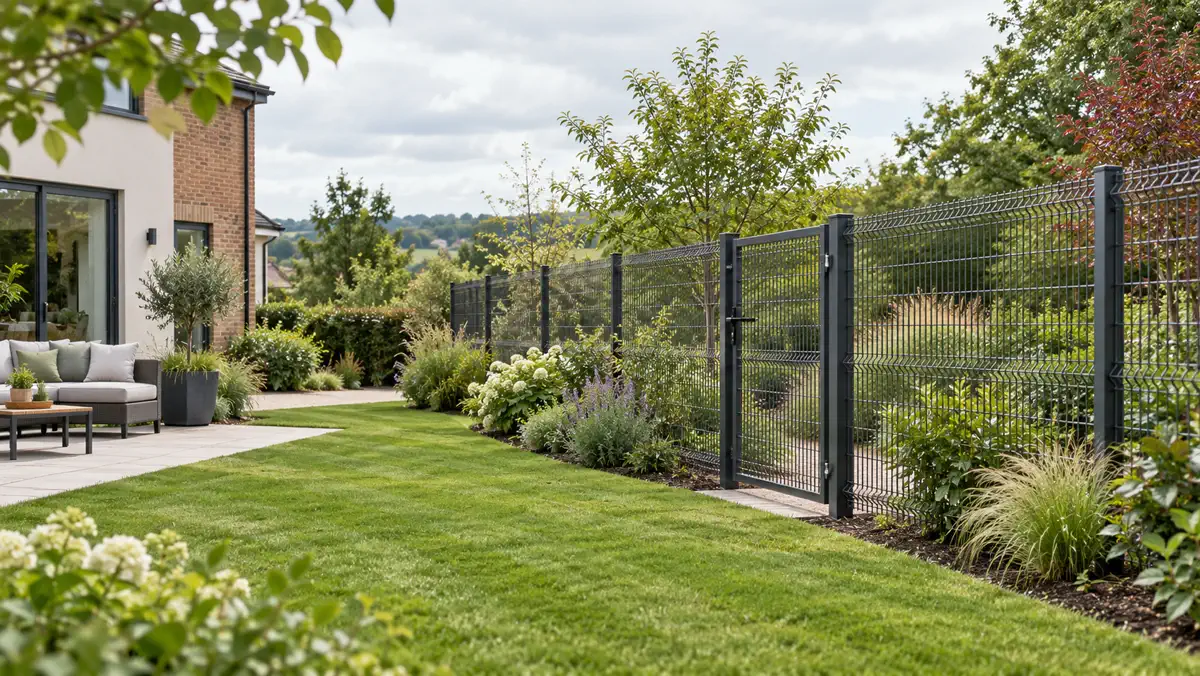
Best Mesh Fencing Options for Garden Security
The best mesh fencing options for garden security combine strength, visibility and an appearance that suits your property. You want a boundary that helps protect your home without making the garden look like a high-security compound.
Modern steel mesh fencing is a durable alternative to traditional timber panels. It allows light into the garden, provides a clear view of the boundary and requires relatively little maintenance. However, with several types available, choosing the right system is not always straightforward.
Here are the main mesh fencing options to consider for your garden.
Why choose mesh fencing for garden security?
Steel mesh fencing creates a strong physical boundary while retaining an open appearance. Unlike solid fencing, it does not create large hidden areas around the edge of a property.
Mesh fencing can help to:
- Deter unauthorised access
- Keep children and pets inside the garden
- Protect sheds, tools and outdoor equipment
- Preserve natural light
- Clearly mark property boundaries
- Reduce ongoing maintenance
Galvanised and powder-coated panels are also designed to withstand the British weather—which, as every garden owner knows, enjoys providing four seasons before lunchtime.
V mesh fencing: the best all-round option
V mesh fencing is one of the best mesh fencing options for garden security because it balances strength, appearance and value.
The panels feature horizontal V-shaped folds that add rigidity without making the fence look overly industrial. Their open design maintains visibility and allows sunlight to reach lawns, borders and planting areas.
V mesh fencing is well suited to:
- Front and rear gardens
- Side boundaries
- Shared residential areas
- Properties beside public footpaths
- Pet-friendly enclosures
- Low- to medium-risk locations
For most residential gardens, V mesh is the logical starting point. It provides reliable everyday protection while retaining a smart and unobtrusive appearance.
656 twin wire mesh: added strength
Homeowners who require a more substantial boundary may prefer 656 twin wire mesh fencing.
The name “656” refers to its wire construction. Each panel uses two 6mm horizontal wires around a 5mm vertical wire. This twin-wire design creates a rigid panel that is harder to bend than standard single-wire mesh.
It is a good option for:
- Large residential gardens
- Communal outdoor spaces
- Apartment developments
- Boundaries exposed to regular public contact
- Homes beside parks or playing fields
- Areas at greater risk of accidental impact
Although stronger than V mesh, 656 fencing still has a relatively streamlined appearance. It offers a useful middle ground between ordinary residential fencing and a heavy-duty security system.
868 twin wire mesh: heavy-duty garden security
For properties requiring a higher degree of protection, 868 twin wire mesh fencing provides a heavier and more rigid solution.
Its panels use two 8mm horizontal wires and a 6mm vertical wire. This makes the fencing highly resistant to bending and impact.
868 mesh may be suitable for:
- Large or secluded properties
- Gardens containing valuable machinery
- Homes with workshops or substantial outbuildings
- Boundaries beside busy public areas
- Higher-risk residential locations
The additional strength comes with a higher cost and a more substantial appearance. For the average suburban garden, it may be more protection than necessary. If your shed contains expensive tools rather than a rusty trowel and three empty paint tins, however, it could be worth considering.
358 mesh fencing: maximum perimeter protection
358 mesh fencing is a specialist high-security system with narrow apertures that make the panels difficult to grip or climb.
It is normally used around commercial, industrial and critical-infrastructure sites. Nevertheless, it may be appropriate for high-value residential properties or secluded locations with specific security concerns.
For most gardens, 358 fencing will be unnecessary. It should be considered when maximum perimeter security is genuinely required, rather than simply choosing the strongest product available.
What height should garden mesh fencing be?
Fence height affects both security and appearance. Taller fencing is harder to climb, but it may dominate a small garden and could require planning permission.
Before ordering, consider:
- Whether the fence is beside a road or footpath
- Local planning restrictions
- Changes in ground level
- The size and layout of the garden
- Whether children or pets use the space
- The effect on neighbouring properties
Planning requirements vary depending on the property and location. Check with your local planning authority before installing a new fence, particularly if it will be beside a highway or taller than the existing boundary.
Do not forget the gate
A strong fence will not provide much security if it is paired with a flimsy gate. Choose a matching mesh gate with a comparable height, construction and protective finish.
The gate should:
- Fit the opening correctly
- Use secure hinges and fixings
- Include an appropriate lock or latch
- Leave no excessive gap underneath
- Match the strength of the surrounding fence
Think of the boundary as a complete system. Fitting heavy-duty fencing beside a weak gate is rather like locking the front door and leaving the window wide open.
Find the best mesh fencing for your garden
The best mesh fencing option for garden security depends on the risks around your property and the appearance you want to achieve.
V mesh is an excellent all-round choice for most homes. The stronger 656 twin wire system suits more exposed boundaries, while 868 mesh provides heavy-duty protection. For specialist high-security applications, 358 mesh offers maximum perimeter security.
CLA Security Fencing Systems supplies steel mesh fencing panels, complete kits, posts, fixings and matching gates throughout the UK. Explore the full mesh fencing range or contact the CLA Security Fencing Systems team for help choosing the right system for your garden.